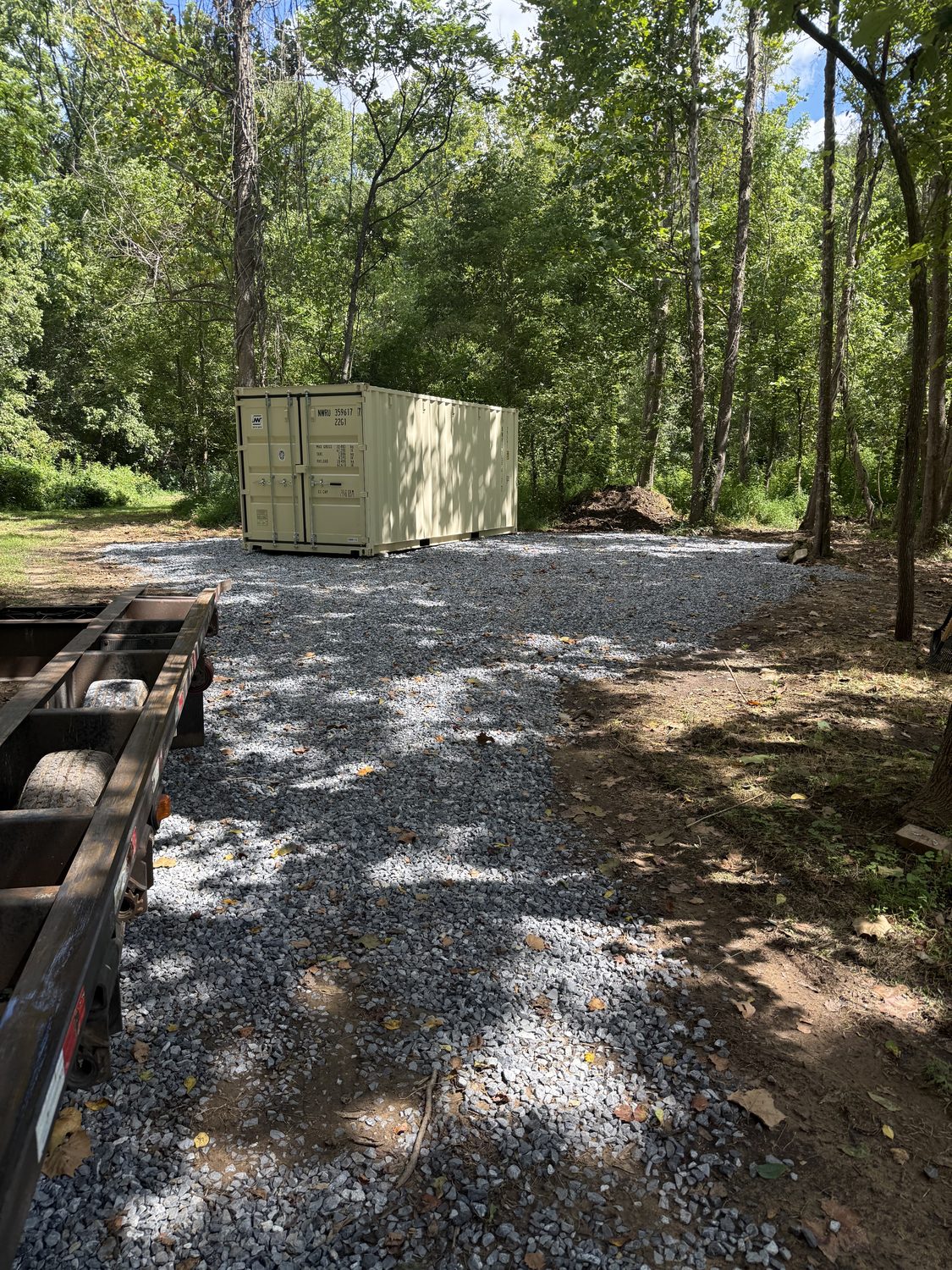
Yadkin County's zoning ordinance marks accessory structures as a permitted use in every district of its Table of Uses and, as far as we found, names no shipping container, but inside Yadkinville and its extraterritorial jurisdiction (ETJ) the town's Development Ordinance governs, and its rule for homes bars a container as an accessory structure "except that a portable storage container may be used as a temporary accessory structure," so settle first whose ordinance covers the parcel.
Jonesville, Boonville and East Bend zone their own land too, while Yadkin County Central Permitting issues building permits "for the county as well as all the towns within the county." We do not pull permits; the owner, a builder or an electrician files them.
Chapter 111 stops at the four town lines and the towns' ETJs
Yadkin County's Chapter 111 applies "within the areas designated as zoning districts on the official zoning map," and Sec. 111-149 says it is not applicable in the incorporated areas of Boonville, East Bend, Jonesville or Yadkinville "or in the established extraterritorial jurisdictions of these municipalities." Read it in the zoning PDF the county's Ordinances page links, a file named as updated 9-3-2024; the Municode copy of the county code is codified through May 20, 2019, and the county says its Zoning Ordinance came after that code.
Yadkinville and Jonesville write ETJs into their own ordinances, the county's Commissioners say they appoint ETJ representatives to Boonville's boards too, and we found no ETJ in East Bend's ordinance. Yadkin County Planning or the county GIS can say which side of a line a parcel sits on, and Yadkinville's own planning page says "For the most up to date zoning, see Yadkin County GIS." Settle the line before you settle the spot.
Every district column in the county Table of Uses marks accessory structures P
Yadkin County's Table of Uses, Sec. 111-280, marks its accessory structures row P, a permitted use, in RA, RR, RL, RG, RI, CP, MHP, CB, HB, MI-1 and MI-2. Sec. 111-615 defines a structure as "anything constructed or erected which is above grade, including a manufactured home and a storage trailer," and an accessory structure as "a structure detached from a principal building on the same zoning lot, the use of which is customarily incidental to the principal building."
We found no section of the posted ordinance that names a shipping, cargo or intermodal container, so a container is classified through those general words, and Sec. 111-31 sends questions of interpretation first to the zoning administrator, with appeal to the Board of Adjustment. If the administrator reads a container as an accessory structure, as county staff have in writing, the rear-yard rule and the district setbacks below decide where it sits.
Planning staff put containers in writing in the TXT25-001 staff report
Yadkin County planning staff have written about containers by name, in the staff report on text amendment case TXT25-001, printed in the Planning Board packets of October 13, 2025, January 12, 2026 and February 9, 2026: "The permanent use of transportable shipping and storage containers is permitted as an accessory structure with NC building code requirements applicable. Their use as temporary structures for construction purposes is allowed in conjunction with Building Permit, which requires a Zoning Permit to be approved first."
That is staff's reading, in a report on an amendment the Planning Board voted to reject on February 9, 2026; it is not ordinance text and approves nothing for any parcel. Read it back to Yadkin County Planning and ask whether the zoning administrator applies it in your district. The building code half belongs to Central Permitting, and our North Carolina container permit guide explains why a 20-ft or 40-ft container misses the state's small-structure exemption.
County accessory structures go in the rear yard, at a setback set by district
A note under Yadkin County's dimensional table, Sec. 111-309, says accessory structures "must be located in the rear yard," the strip between the rear lot line and the rear building setback line. Side and rear setbacks run from the property lines to the structure's "outer wall at the point where the structure meets the ground." The county Board of Adjustment hears variances from the rule; its September 14, 2026 agenda carried a request "to vacate the rear yard placement requirement for accessory structures."
| District | Side | Rear |
|---|---|---|
| RA Rural Agricultural, and RR, RL and RG residential | 12 feet | 15 feet |
| CB Community Business, HB Highway Business | 15 feet | 15 feet |
| MI-1 and MI-2 Manufacturing Industrial | 20 feet | 20 feet |
| CP Conservation Protected | 50 feet | 50 feet |
We found no accessory line for RI and no row for MHP; ask Planning. Confirm your district and its numbers with Planning before you choose a spot.
The tilt-bed truck has to reach the back of the lot to set a box in the rear yard, and a 40-ft needs about 95 feet of straight pull-in, a 20-ft about 65, so check the lane before you settle on the spot.
Storage as a lot's main building is a special use in RA, RR, RL and RG
Yadkin County's Chapter 111 ties an accessory structure to a principal building on the same lot, so bare land raises a different question. Its use for storage as the main building is "Residential storage facilities," defined as "an off-premises building classified as the principal structure on a lot, used for the storage of personal property," a special use in RA, RR, RL and RG with a 3,000-square-foot maximum, setbacks at least those of single-family dwellings, and a structure "of compatible construction with the surrounding area."
The Board of Adjustment grants special use permits after an evidentiary public hearing, with the application due at the county planning office "by at least 30 days before the board of adjustment meeting." Whether a container on bare land fits this use is the zoning administrator's call, so ask Planning before a delivery date is set.
The bona fide farm exemption is a zoning exemption, confirmed on a county form
Yadkin County's Chapter 111 says its provisions "shall not apply to bona fide farms," while "any use of farm property for non-farm purposes is subject to these regulations." Planning confirms the exemption on a "Farm Exemption from Zoning Regulation Authorization" form that cites G.S. 160D-903 and asks for a Farm Tax ID number. The exemption is from zoning: the county's residential zoning permit application says "For all residential construction on bona fide farm property, no NC Building Code exemptions apply." Whether a container serving the farm itself needs a building permit is Central Permitting's call, and the same question across Virginia, West Virginia and North Carolina is in our answer on whether farms need container permits.
Flood hazard land and the watershed overlay can each add a county permit
Yadkin County's Chapter 103 requires a floodplain development permit before any development in a special flood hazard area within its jurisdiction, and development there includes the "storage of equipment or materials." In those areas "Accessory structures shall not be temperature-controlled," and they may not be used for human habitation, which the chapter says includes working areas, so put an insulated workshop plan to the floodplain administrator at (336) 849-7905 first. For what wet ground does to the steel itself, read can a container go in a floodplain. Yadkinville applies its own flood standards in town and in its ETJ, and Boonville keeps a flood damage prevention ordinance of its own.
On land in the county's Watershed Overlay, Chapter 109 can require a watershed protection permit before a building permit issues, and it counts "buildings, pavement, gravel areas" as built-upon area; in the WS-IV watersheds it reaches only new development that needs an erosion and sedimentation control plan. Ask Planning which applies, with the container's footprint and any new gravel pad measured.
Beside a Yadkinville home, a container can serve only as temporary portable storage
The Town of Yadkinville's Development Ordinance, as posted in 2026, defines a container as "any portable storage container, or a standardized shipping container used for intermodal freight transport," and section 3.5.2.2 says "Under no circumstances may a vehicle, tractor trailer, manufactured home, recreational vehicle, or container be used as an accessory structure," then allows a portable storage container as a temporary accessory structure. Subsection H.3 sets the terms:
- up to 30 days, or "for the duration of the construction project" when the container is used in association with construction on the same site, removed on completion
- no more than two on a lot with a single-family or duplex dwelling
- on such a lot, a gross square footage that "shall not exceed 150 square feet"
- a place on the lot and outside any street right-of-way
Our page on the 20-ft container lists about 160 square feet of floor, so ask the town whether it treats a shipping container as a "portable storage container" and how it measures one against 150 square feet. That is the Planning Department's call, not ours.
The town's forms page says all accessory structures "must receive a permit prior to construction or placement on property," and the ordinance says "No Building Permit shall be issued by Yadkin County" until the town's zoning permit is approved. The town also requires "a principal structure on any lot for which there is an accessory structure." For nonresidential uses, section 3.5.8.1 keeps vehicles, trailers and containers from serving as accessory structures except in the LI and HI districts, where they must sit in the rear yard, screened from adjacent properties and any public right-of-way. For new nonresidential and multifamily development, the design standards say shipping containers "shall not be used as permanent structures unless such meet NC Building Code, are placed on a permanent masonry foundation, and meet all of the other design standards" for their district. Ask the Town of Yadkinville Planning Department, (336) 679-8732, and see our Yadkinville container delivery page for the delivery side.
Jonesville, Boonville and East Bend keep their own zoning desks
The Town of Jonesville's zoning ordinance covers the town "and its extraterritorial planning jurisdiction," and nothing is built or moved there until the Zoning Enforcement Officer issues a zoning permit and the county issues a building permit; we found no container term in the zoning articles the town posts. Boonville's code is posted as page images that could not be searched, so ask its Zoning Officer whether it addresses containers. Boonville's permit application holds permits until, among other steps, "a site inspection is performed by the zoning officer and applicant," which is the time to show the spot and the lane.
East Bend's ordinance applies "within the corporate limits of the Town of East Bend," defines a shipping container in Sec. 401.57 to include "intermodal shipping containers, body of transport trailers, or straight truck boxes," and marks "Shipping container structures" C, conditional, in the HC Highway Commercial and I-1 Industrial columns of its Table of Permitted Uses, a use its Board of Adjustment decides through quasi-judicial procedure.
| Desk | Handles | Phone | Address |
|---|---|---|---|
| Yadkin County Planning | County zoning, the farm exemption form, floodplain, watershed | (336) 849-7905 | 213 E. Elm Street, Yadkinville |
| Yadkin County Central Permitting | Building permits and inspections, county and all four towns | (336) 849-7905 | 213 E. Elm Street, Yadkinville |
| Town of Yadkinville Planning Department | Zoning in town and its ETJ | (336) 679-8732 | 213 S Van Buren Street |
| Jonesville Town Hall, Zoning Officer | Zoning in town and its ETJ | (336) 835-3426 | 1503 NC Highway 67 |
| Boonville Town Hall, Zoning Officer | Zoning in town | (336) 367-7941 | 110 Carolina Ave North |
| East Bend Town Hall, Zoning Administrator | Zoning inside the corporate limits | (336) 699-8560 | 108 W Main Street |
As each office's own page listed them in September 2026. Both county desks keep Monday to Friday, 8:00 a.m. to 5:00 p.m., and Central Permitting issues no permits after 4:30 p.m.; call before you go.