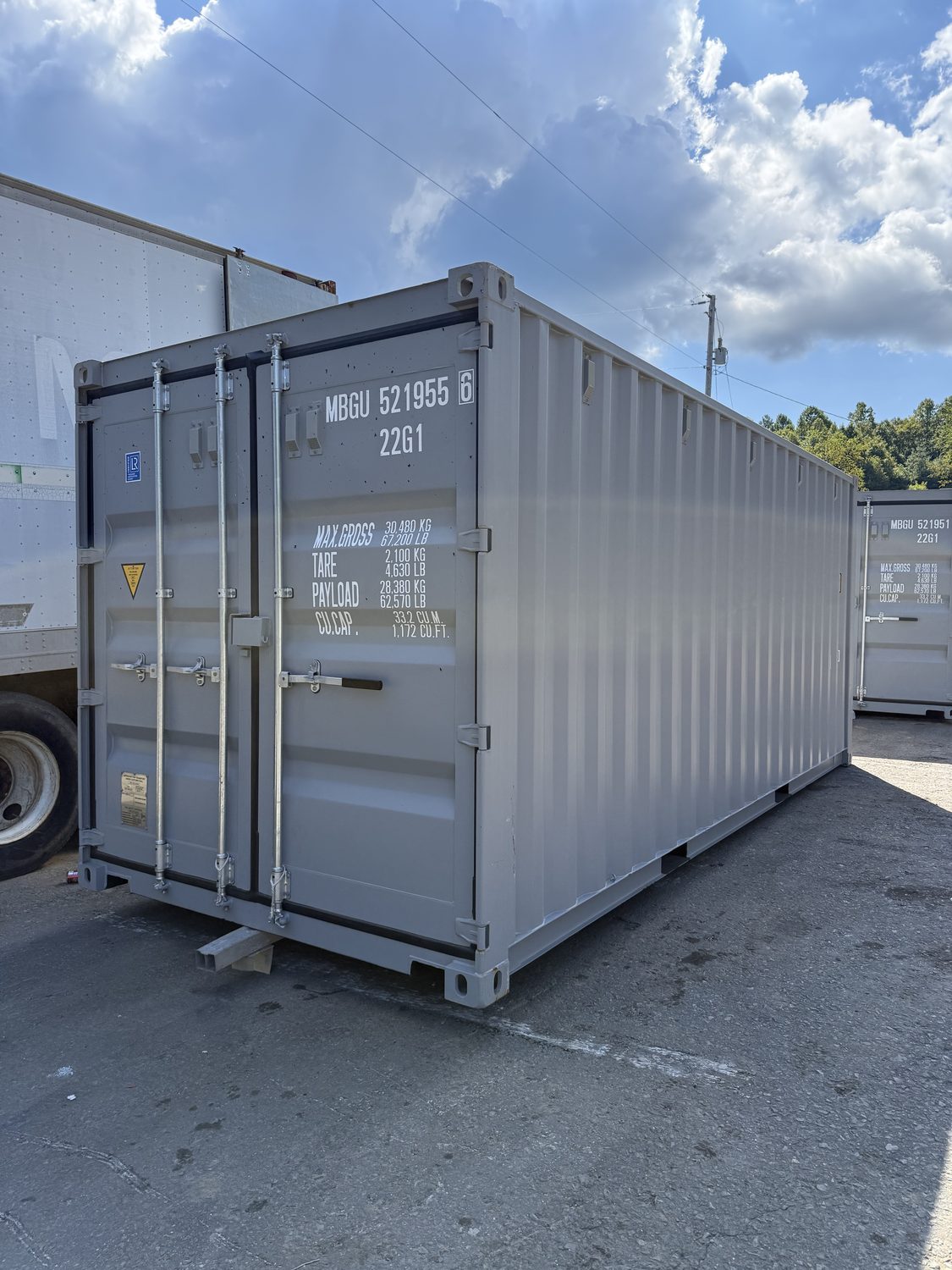
Bland County runs along I-77 between Wythe County and the West Virginia line, and by every surface reading it is farm and mountain ground. That is precisely why buyers get this county backwards. Carroll County, where our yard sits, has no adopted countywide zoning. Wythe County next door has none either and is still drafting its first. Bland County has been zoned countywide since the mid 1990s, under Chapter 62 of the county code.
It also has a feature no other county we have written up shares: there are no incorporated towns inside it. None. So the paragraph you find on most of our county pages, the one about a parcel answering to a town rather than a county, has nothing to attach to here. One office holds every placement question in the whole county.
What follows is what the ordinance says about a steel storage box, which is close to nothing, the two provisions worth naming by section number when you call, the sentence in Chapter 62 that ties the state building code exemption to the county zoning permit, and a flood chapter that can send the same parcel to a second desk. We do not pull permits and we are not code officials. This is the reading you do before the phone call, not the answer.
Adopted countywide zoning, carried in Chapter 62
Sec. 62-4 states its own authority: "This chapter and map are adopted according to the authority of Code of Virginia, sections 15.2-2280 through 15.2-2316, as amended." Every section in the chapter carries the derivation line Ord. of 7-24-95. Sec. 62-5 sets the reach: "The provisions of this chapter shall apply to all land within the unincorporated territory in the county." Because there is no incorporated territory in Bland County at all, that language covers every parcel rather than carving anything out.
One wrinkle, so it does not trip you up in conversation: the code derives from an ordinance dated July 24, 1995 and the official map carries the same date, while the county's comprehensive plan says a zoning ordinance was adopted in 1996. The year is not the point. The ordinance dates to the mid 1990s and it is in force.
Four districts, and not one of them is residential
Sec. 62-201 divides "the unincorporated areas of the county" into Agricultural (AG), Commercial (C), Industrial (I) and Manufactured home parks (MHP). That is the whole list. Most private ground here falls in AG, which matters a great deal further down this page. It is also the structural opposite of our Pulaski County write up, where the tightest container language sits in the residential districts. Bland has no residential district for such a rule to live in.
Sec. 62-203 makes the official map dated July 24, 1995 the controlling document, and subsection (d) says it "shall be located in the office of the zoning administrator and shall be the final authority as to the current zoning status of areas within the jurisdictional limits."
There are no town limits here, because there are no towns
This is the finding that makes Bland County easier than its neighbors, and it comes from the county's own documents rather than from us. The comprehensive plan adopted on May 22, 2018 states: "Bland County is one of the only counties in the nation without an incorporated town. Bland instead has various unincorporated communities throughout the county." The plan names the recognizable ones as Hollybrook, Bastian, Bland, Rocky Gap, Ceres and Mechanicsburg.
The county restated it in the 2026 comprehensive plan posted to its site in July 2026, which counts 24 unincorporated communities. That document is a final draft and we found no evidence it has been adopted, so we cite it as a draft. A plan is not an ordinance either way.
So a Bland or a Rocky Gap mailing address does not place you inside anybody's municipal boundary. Those are communities and postal addresses, not governments, and there is no second set of ordinances underneath the county's. Be careful with search results here. More than one secondary source states confidently that Bland and Rocky Gap are incorporated towns. The county's own adopted plan and its current draft say the opposite, and the zoning chapter's unincorporated territory language backs them up.
The ordinance never names a private storage container
We read the definitions at Sec. 62-1 straight through. There is no definition of shipping container, storage container, cargo container, conex, semi-trailer or portable storage unit anywhere in the chapter, no permitted use listing for one, no cap per parcel, no day count and no container permit. That is the honest headline, and a reader who wants a yes or a no in writing is not going to find one here.
Silence is not a green light and it is not a prohibition. It means the classification gets made by the zoning administrator against your district, and two provisions come close enough that you should raise them by number.
The one place the code says the words, and why it is not about you
Sec. 62-242, uses permitted in the Commercial district, includes at item (55): "Mobile storage unit parking, sales and service with a conditional use permit." That governs a business that parks, sells or services mobile storage units, the approval a dealer would need to open a lot here. It is not a rule about a landowner setting one box behind a barn, and anybody quoting it at you as though it were has misread which list it sits in.
The provision a buyer is more likely to feel
Sec. 62-222 lists the uses permitted in the Agricultural district, and item (10) reads: "Accessory uses, as defined, with a conditional use permit." Sec. 62-1 defines an accessory use as "an activity or structure that is customarily incidental to and subordinate to an existing established principal activity and/or structure and is located on the same lot as the principal structure."
Read literally, that puts an accessory structure in the AG district behind a conditional use permit rather than a counter transaction, and most private ground in the county is AG. Whether the county applies that item to a storage box beside a house or a barn is not published anywhere, and we are not going to supply an answer the county has not given. What we can give you is the section number, which turns a vague question into one the office can answer in a minute.
| Zoning application | Fee in the ordinance |
|---|---|
| Rezoning or amendment of the chapter or the zoning map | $100.00 |
| Conditional use permit | $100.00 |
| Variance, to the board of zoning appeals | $200.00 |
| Appeal, to the board of zoning appeals | $300.00 |
County fees, not ours, read off the code as codified through an ordinance of October 22, 2024. No zoning permit fee is published in the ordinance, and the county's building fee page carries no zoning permit or accessory structure line either. Ask the county for the current amount before you budget.
What else we checked, and did not find
- Article VI, the supplementary district regulations, has no screening standard, no outdoor storage rule and no paint or condition requirement. It covers fences (six feet maximum, Sec. 62-285), junkyards and automobile graveyards (prohibited, Sec. 62-286), height, home occupations, parking, signs and manufactured homes
- Sec. 62-287 says an accessory structure may not exceed the height of the principal structure, except for garages or farm buildings put up after a residence. The AG district's maximum height is 35 feet under Sec. 62-223
- Sec. 62-297 is the catch all: a use "not specifically named but compatible with other permitted uses" may be permitted after review by the zoning administrator and approval by the planning commission, following a public hearing under Code of Virginia section 15.2-2204
- Sec. 62-271(2) allows construction trailers and portable or temporary buildings for offices and storage tied to a bona fide construction project, for one year or 30 days past the certificate of occupancy, whichever comes first. That clock sits only inside the Manufactured Home Parks district, so do not carry it across the county as a jobsite rule
- We found no yard or setback schedule for the AG district, and minimum lot size is deferred to the Chapter 46 subdivision provisions, which we did not read. Ask for your setbacks rather than assuming there are none
One sentence ties the state exemption to the county zoning permit
What the statewide exemption already covers
13VAC5-63-20, Section 102.3 Exemptions, item 11 takes an intermodal freight, moving or storage container placed on site for use as a storage container out of the Virginia Uniform Statewide Building Code, and 13VAC5-91-20(E) does the same on the industrialized building side. What triggers it is what the box is used for, not what it is built from and not how many months it sits there. Put people or a business inside it and the exemption is behind you, with section 3115 of the Virginia Construction Code taking over. Our Virginia permit guide quotes both regulations at length.
Bland County adopts that same statewide text. Sec. 14-1 adopts by reference "that volume of the Virginia Uniform Statewide Building Code entitled Volume I, New Construction Code," and Sec. 14-2 says the building department enforces it. The county's building permit page states a permit is needed before constructing, enlarging, altering or changing the use of a structure, and publishes no exemption list of its own. Its fee schedule shows no shed or accessory structure line, only a per square foot figure plus flat fees and a 2 percent surcharge. Those are the county's figures, not our prices.
The zoning permit is a separate instrument, and here the code links them
That second sentence is unusual. Across the counties we have written up, this is the only ordinance that writes an explicit bridge from the building permit exemption over to the local zoning permit. Set it beside item 11 of the state exemption and a literal reading points somewhere obvious.
We stop there on purpose. Whether that carry through relieves your placement of a zoning permit, and how it interacts with the conditional use permit language at Sec. 62-222(10), is the zoning administrator's determination, and it is not written down anywhere we could find. A page guessing at it is how somebody ends up moving a container they already paid to have set. Put the sentence in front of the office and let them answer it. Question three below is written to do that.
Two more things while permits are on the table. Permits of every kind attach to the parcel itself, and the filing is done by the owner, or by the builder or the electrician working for them. We do not pull them. And on a modified unit, our Woodlawn shop sets the sub-panel, conduit, boxes, outlets, switches and fixtures, then a licensed electrician you hire makes it live and carries it through inspection under your own county's rules. Nothing leaves the yard energized: the circuits sit in place and dead until that visit happens.
Chapter 30 is a different permit, from a different desk
Bland County has an adopted flood ordinance, Chapter 30, Article II, Flood Damage Prevention, originally from an ordinance of November 28, 1988 and comprehensively amended in 2008. Sec. 30-36 applies it "to all areas of special flood hazard within the jurisdiction of the county," and Sec. 30-37(a) adopts the FEMA Flood Insurance Study dated April 2, 2008 and its maps by reference. AE zones carry published base flood elevations; A zones are approximate, with no profiles.
The reason this chapter belongs on a container page is one definition. Sec. 30-31 defines development as "any manmade change to improved or unimproved real estate, including, but not limited to, buildings or other structures, mining, dredging, filling, grading, paving, excavating, drilling operations or permanent storage of materials." A loaded box on the ground is, on the face of that sentence, permanent storage of materials.
Sec. 30-63 then requires a development permit "prior to the commencement of any development activities," and Sec. 30-61 puts that permit in the building official's hands rather than the zoning administrator's. That is the practical takeaway: in Bland County a flood question and a zoning question go to two different people sharing one small office.
Keep the instruments separate. The storage exemption in the building code is a building code exemption and it does not reach Chapter 30. A container that needs no building permit can still sit inside a mapped special flood hazard area where the county's own definition of development covers storage of materials. We are not telling you a development permit is required for your box. We are naming the section and sending you to the building official. If any part of the ground runs to a creek bottom, ask before the truck is scheduled. Our short answer on containers in a floodplain covers the general case.
One office, one number, the whole county
Zoning, building and planning sit in a single department at the courthouse in Bland, and because there are no towns there is no second directory to work through.
Bland County Building, Planning, and Zoning
- 612 Main St., Suite 204, Bland, VA 24315
- Mailing: P.O. Box 510, Bland, VA 24315
- (276) 688-4622
- Monday to Friday, 8:30 a.m. to 5 p.m.
Joel Cagle, CBO, is the Building Official and Dena Monroe is the administrative assistant. Building permit submissions go to the Building Official at the address above, and the county publishes jcagle@bland.org for that desk.
On the zoning side, ask for the office by title rather than by name. The county does not publish who currently holds the zoning administrator designation, and Sec. 62-91 leaves that appointment to the board of supervisors, so we will not attach a name to it.
County administration answers on the same main line, with a toll free line at (800) 519-3468 and a fax at (276) 688-9758. The Planning Commission meets the first Monday of every month, chaired by Jerry Mercer. That is the body Sec. 62-297 routes an unnamed use to, after a public hearing, if it comes to that.
Numbers, hours and staff move. Everything above was read off Bland County's own department, contact and planning pages when this page was written, and the county, not us, is the authority on it.
One department, one call, and the five things to get out of it
Nobody can look this up for you online, so the first job is finding the tax map number or the 911 address for the parcel and keeping it where you can read it. Then tell the office plainly what you are actually doing, which is putting a steel box on your own ground to keep things in, and take these in order.
- What district is this parcel in on the official zoning map? You cannot answer this one yourself, because the official map lives in the zoning administrator's office under Sec. 62-203(d) and the county's GIS viewer is behind a login.
- In that district, is a storage container treated as an accessory use under Sec. 62-222(10), which reads "accessory uses, as defined, with a conditional use permit," or is it handled some other way? If a conditional use permit is the answer, ask what the application and hearing timeline looks like.
- Sec. 62-116 says activities exempt from building and electrical permit requirements are also exempt from a zoning permit, and a container used for storage is exempt from the building code under 13VAC5-63-20, Section 102.3, item 11. Does that mean no zoning permit for this placement, or do you still want one?
- Does any of this parcel fall inside a mapped special flood hazard area under the April 2, 2008 Flood Insurance Study, and if so, does setting a container there count as development needing a permit from the building official under Sec. 30-63? Ask even if the ground looks high and dry, because Sec. 30-31 reaches permanent storage of materials.
- What do I have to hold off the property lines, the road right of way, the well and the septic field, and does the county cap how many accessory structures one parcel may carry? Ask them to point you at the section.
If the box is going in for the run of a build rather than for good, say so at the start, because it can change the answer. Write down the name of whoever you spoke with and the date on the same sheet as your parcel number, and if you are going to rely on the answer, ask for it back in an email.
No published road miles for Bland County, and a lane that has to fit
Here is the one thing we will not do on this page. We publish free delivery and leveling within 75 road miles of our Woodlawn yard, and that ring is measured in road miles rather than in a straight line off a map. We do not publish a distance for anywhere in Bland County and we will not estimate one for you in either direction. Give us the 911 address or the tax map number, and we will confirm the road miles for your parcel and put the number in the quote, which comes back the same day.
Access, not paperwork, is what ends most drops up here. A narrow farm lane, a gate post set too close to its neighbor, a limb hanging over the track, ground gone soft after a wet week: any one of those stops a delivery the ordinance would have allowed. So measure before you order. Reckon on a clear straight run of roughly 65 feet into the spot for a 20-ft, and 95 feet before a 40-ft can come off the trailer, with that clearance holding overhead along the lane and not only above the pad. Our delivery preparation guide walks through the measuring. Photographs of the lane, the gate and the spot tell us more in ten seconds than a paragraph will, so put a few in with your address.
If the spot is timber or hunting ground with no drive to it, read containers on hunting land first, because on ground like that the drive in is the whole question.
What is actually standing between you and a box on this ground
Bland County publishes more usable code than its size suggests, and none of it forbids a storage container. The ordinance simply never mentions one. What the county does have is a zoning layer over every parcel, a mostly agricultural district list where accessory uses carry a conditional use permit, a sentence bridging the building code exemption to the zoning permit, and a flood chapter whose definition of development reaches stored material.
So two determinations settle almost every placement here, and both come out of one call to (276) 688-4622: what district the parcel is in and how the county treats a container in it, and whether a zoning permit is wanted given Sec. 62-116. Add the flood question if you are near water. All of it is easier before a container is on your ground rather than after. Our trade is selling and delivering containers, not practicing law and not administering code. Where Bland County's zoning administrator or its building official reads any of this differently, their reading is the one that governs and ours is not.
Once the district is answered and the spot is picked, the rest is the usual arithmetic. A used cargo-worthy 20-ft runs $3,200 delivered and a 40-ft around $4,900, both of them with free delivery and leveling within 75 road miles of the yard. Renting instead, a 20-ft is $165 a month and a 40-ft $235 a month. Either way a welded lockbox rides out on the doors, bought or rented, so security never becomes a line you had to plan for. Still weighing the two? Buy versus rent works the break even out at about 18 to 20 months.