Outside the Town of Sparta and its extraterritorial jurisdiction (ETJ), Alleghany County does not split land into zoning districts: the county's posted copy of its 2006 Property Rights Protection Ordinance says "All the territory within Alleghany County's planning jurisdiction shall be within one district", an approach it calls "a flexible, innovative land use management system, as opposed to the traditional Euclidean zoning system". For a shipping container, the question is therefore not which district a parcel is in but how the ordinance classes the project, and the ordinance says "Prior to submission of an application, the developer should meet with the Administrator" to settle that.
We found no rule for shipping or storage containers in the county's posted land-use, flood, watershed or Roaring Gap ordinances, or on its building permit forms, so the answer that counts comes from an office: Alleghany County Planning & Inspection outside Sparta and its ETJ, and the Town of Sparta inside them, with the county still asked about the building permit. Containers Delivered files nothing with either one.
How the 2006 ordinance sorts a use instead of a parcel
Because every parcel under Alleghany County's Property Rights Protection Ordinance sits in the same open district, the ordinance sorts uses instead: its posted copy lists prohibited, exempt and by-right uses, then says "All other uses, including all changes of use, not specifically prohibited, are required to obtain a conditional use permit issued pursuant to requirements found in this ordinance."
- Prohibited: nuclear waste facilities, and incineration, landfill or waste disposal facilities the county did not establish for its own solid waste. A storage container is not on that list.
- Exempt, with no compliance permit: among the listed uses, single-family dwelling units on an individual lot, incidental agriculture with a home if not objectionable, and "bona fide farm, forestry or logging operations on a temporary basis, or portable sawmill".
- Use by right, with a compliance permit from the Administrator: expansions of commercial, industrial or institutional uses and certain new uses of developed sites, on the ordinance's conditions.
- Conditional use: the rest, through a Planning Board permit after a public hearing with newspaper notice and first-class mail to affected or adjoining owners within 2,000 feet.
None of the listed items names a shipping container, a storage building or an accessory structure, and the categories run from no compliance permit to a public hearing, so the category is the first thing to learn. On a farm, take the farm item as written and ask whether a storage container falls inside it; the broader farm question is taken up in our answer on whether farms need container permits. For contrast, Grayson County, Virginia, runs a zoning ordinance with districts, which the Grayson County container permit guide reads.
Alleghany's definitions name a storage trailer, not a shipping container
Alleghany County's Property Rights Protection Ordinance defines several words a container could fall under, and choosing among them is the Administrator's reading:
- "Development" includes "storage of equipment or materials", alongside buildings, filling, grading and paving.
- "Structure" is "Anything constructed or erected which is above grade including a manufactured home and a storage trailer", less listed landscape features such as walls, fences and driveways.
- An accessory structure is "detached from a principal building on the same zoning lot".
We found no mention of a shipping container in any of them, so describe the box plainly when you meet: what it will hold, and whether it will ever be wired, insulated or used as a place to work.
We found no yard setback for a single-family lot or an accessory structure in the ordinance either: its yard table covers duplexes and multi-family buildings and leaves commercial, industrial or institutional setbacks "to be determined by the Planning Board". Ask the Planning & Inspection office what distance applies to your spot.
Before any application, a meeting with the Administrator
Under Alleghany County's Property Rights Protection Ordinance, a developer should meet with the Administrator before applying, to determine whether a proposal is a prohibited or an exempt use and whether a compliance permit or a conditional use permit is required. If the proposal is an exempt use, the posted copy says "the developer will not be required to meet the provisions of this Ordinance"; if a compliance permit is required, the developer applies for one.
The Board of Commissioners appoints the Administrator. We found no page naming who holds the post, but the county's Planning & Inspection page links the ordinance, so ask that office for the meeting. Applications come from "The owner of the property or their authorized agent", and we do not pull permits, so the request is yours to make.
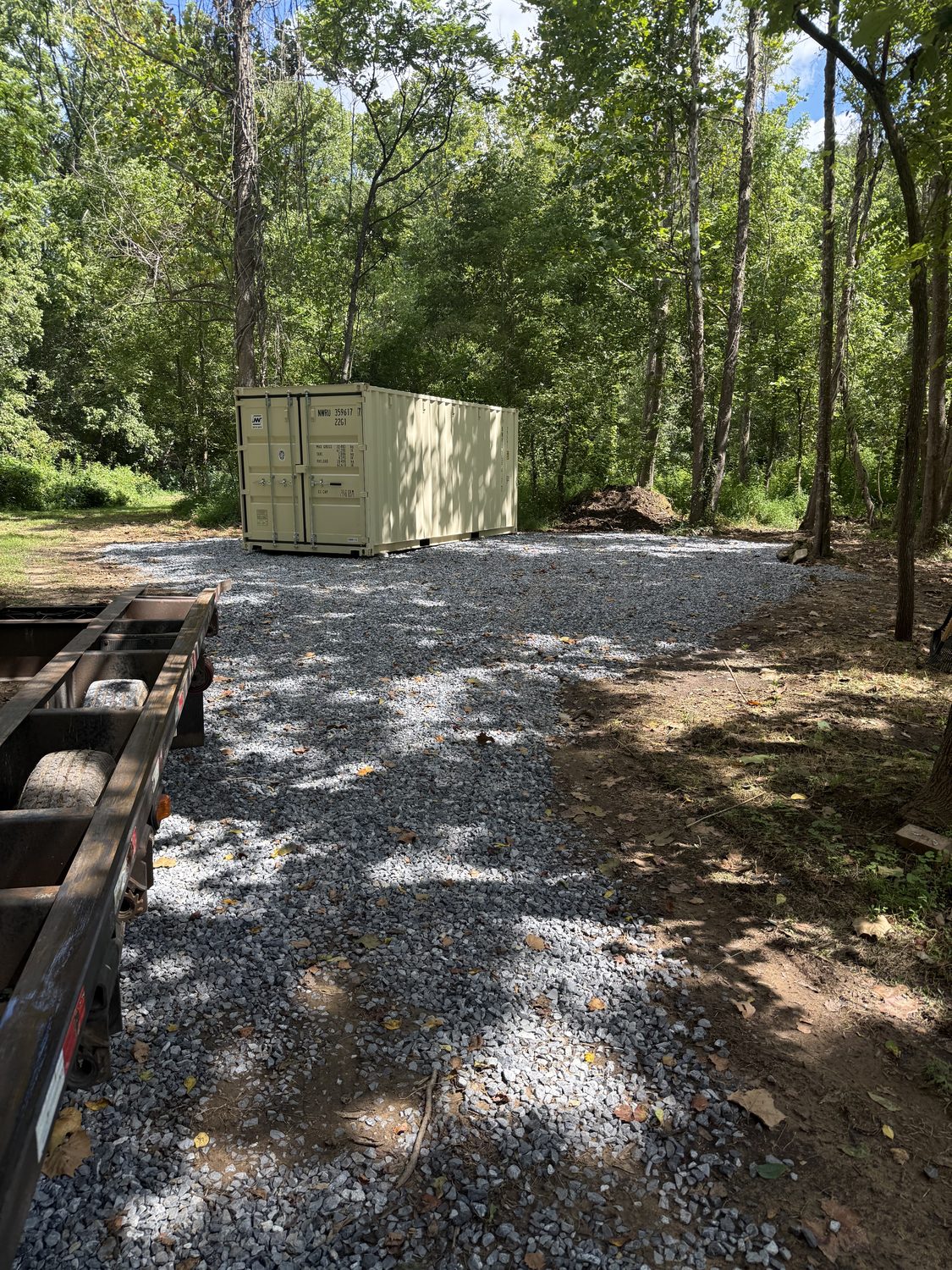
Bring the facts the sorting turns on: the parcel number or address, what the container will hold, whether a house, a farm or a business already uses the land, and where on the parcel it will sit. Choose that spot with the truck in mind as well: a tilt-bed needs about 65 feet of straight pull-in for a 20-ft container and about 95 feet for a 40-ft.
What the county's building permit paperwork asks about a site
In Alleghany County, the building permit is a separate track in the same Planning & Inspection office; the statewide small-building exemption, and why a container falls outside it, is argued on our North Carolina container permit guide.
The county's fee sheet, effective July 1, 2022, says: "Decks and Utility buildings over 400 square feet or is longer than 12’ on one side are required to have a permit". We found no container on that sheet, so whether a container is a utility building there, falls under another line, or under none is the Planning & Inspection office's call. On cost, the county's FAQ answers its own question with "It depends on the type of permit and the square footage of the project."
The building permit application has an office-use box that asks whether the site is in a watershed, in high quality water or in a flood plain, how far it is from a stream and which one, whether it is "Near the Parkway", and a ridge name and elevation.
The owner packet's erosion control statement asks about land disturbing activities within 25 feet of a lake or natural watercourse or of trout waters, or over one acre, and says "A Yes answer to any of the above questions indicates that an approved Erosion Control Plan is required prior to issuance of an Alleghany County Building Permit." Answer it for the pad and the lane, not just the spot where the box will sit.
Flood hazard areas bring a permit of their own under the 2009 ordinance
Alleghany County's Flood Damage Prevention Ordinance, adopted August 17, 2009, applies "to all Special Flood Hazard Areas within the jurisdiction of Alleghany County", the areas its adopted flood maps show. Inside them, a Floodplain Development Permit is required "prior to the commencement of any development activities within Special Flood Hazard Areas", and the ordinance's definition of development includes "storage of equipment or materials". Whether setting a container in one is development under those words is the Floodplain Administrator's call.
The county's 2024 Strategic Plan says flood zones in the county largely coincide with the New River and the Little River, the most significant along the Little River where it runs through the Town of Sparta. That is a general description, not a parcel map, so ask whether your spot is in a Special Flood Hazard Area before you settle on it.
The permit application goes to the Floodplain Administrator, named in the ordinance as "The Alleghany County Planner and/or the Alleghany County Manager", with a scaled plot plan that carries "the certification of the plot plan by a registered land surveyor or professional engineer". That is one reason to ask whether another spot on the parcel sits outside the hazard area; choosing drier ground is covered in our answer on putting a container in a floodplain.
In flood hazard areas "where Base Flood Elevation (BFE) data has been provided", accessory structures "shall not be used for human habitation (including working, sleeping, living, cooking or restroom areas)" and "shall not be temperature-controlled", and must be firmly anchored and have flood openings. Under the same condition, a temporary non-residential structure needs an approved removal plan, and its permitted time "may not exceed three (3) months, renewable up to one (1) year". Whether a container is either one is the Floodplain Administrator's reading, so settle it before ordering insulation or an electrical rough-in from the Woodlawn shop for a box headed to a hazard area.
Water supply watersheds and the Roaring Gap district
Alleghany County's watershed ordinance, revised December 1, 1997, applies "within the areas designated as a Public Water Supply Watershed" on a Watershed Protection Map that is not in the posted copy. The county's 2024 Strategic Plan maps Fisher River, Elkin Creek and Reddies River as WS-II watersheds on a reference map it calls "not for survey or legal uses", so ask the Planning & Inspection office whether your parcel is inside one.
Inside a watershed area, the ordinance says: "Except where a single family residence is constructed on a lot deeded prior to the effective date of this ordinance, no building or built-upon area shall be erected, moved, enlarged or structurally altered, nor shall any building permit be issued" until the Building Inspector has issued a Watershed Protection Permit. Built-upon area there includes "buildings, pavement, gravel areas", so the gravel pad matters as much as the box. Whether a container and its pad count against the ordinance's built-upon limits is the Building Inspector's call, asked at the same county office, since the County Planner's duties include watershed protection.
The Roaring Gap Community has its own 1999 ordinance, under which land in that district "shall be used only for residential purposes, and such recreational and ancillary activities as have been historically, and are presently, located here". Its boundary is on a map that is not in the county's posted text, so for a parcel near Roaring Gap, ask the Planning & Inspection office whether the land is inside the district and whether a storage container fits those words.
Inside Sparta or its ETJ, the town handles zoning
Sparta is the exception written into Alleghany County's land-use ordinance, which covers "all land lying within the borders of Alleghany County, except that land currently within the town limits of Sparta and its extraterritorial jurisdiction". The town runs zoning of its own: a 2026 hearing notice speaks of "all areas subject to the Town of Sparta Zoning Ordinances", a May 5, 2026 council agenda listed a public hearing on rezoning a parcel "from R-A (Residential-Agriculture) to NB (Neighborhood Business)", and the town's code has its own chapters on zoning, floods and building regulations.
Where the ETJ runs is the town's to say: the county's 2024 plan maps show a "Sparta ETJ", but we found no published description of its line. Ask the Town of Sparta at Town Hall, 304 S. Main Street, (336) 372-4257, where the town lists a Planning & Code Enforcement role, whether your parcel is in town, in the ETJ or outside both, and what its zoning asks of a container; we could not open the text of the town's zoning chapter.
We found no statement of which office issues building permits inside the town, so ask the county's Planning & Inspection office too, and put a flood question near the Little River to both. Getting the container up to Sparta, about 32 road miles from the Woodlawn yard, is its own subject on our Sparta shipping container page.
County desk or town desk, both on South Main Street in Sparta
Alleghany County's Planning & Inspection office and the Town of Sparta's Town Hall both have South Main Street addresses in Sparta, and they answer for different land.
| Your parcel | Office | What to ask |
|---|---|---|
| Outside Sparta and its ETJ | Alleghany County Planning & Inspection, County Administration Building, 348 South Main Street, Office 130, Sparta; 336-372-8974 | Is a storage container here exempt, a use by right or a conditional use? Does it need a building permit, and under which fee sheet line? |
| In a Special Flood Hazard Area | The Floodplain Administrator, through the same county office | Which flood map governs this spot, and is the container an accessory or a temporary structure? |
| In a water supply watershed | The watershed ordinance's Building Inspector, same county office | Do the container and its gravel pad count as built-upon area? |
| Inside Sparta or its ETJ | Town of Sparta, Town Hall, 304 S. Main Street, Sparta; (336) 372-4257 | Is the parcel in town, in the ETJ or outside both, and what does town zoning ask of a container? Then ask the county about the building permit. |
The county's page lists the County Planner as available 8:00 a.m. to 5:00 p.m., Monday through Friday, and its permit packet says every structural permit is done in person and asks applicants to call before coming; we found no hours published for Town Hall.
The county's 2024 Strategic Plan says "some language and provisions may be outdated or not in compliance with State statutes", so the office's current answer outranks any posted copy. The county ordinance also says "It is not intended that these regulations interfere with any easements, covenants, or other agreements between parties", so a deed restriction or an association's rules need their own reading. The town-or-county question in general gets its own treatment in our answer on who to call about container zoning.