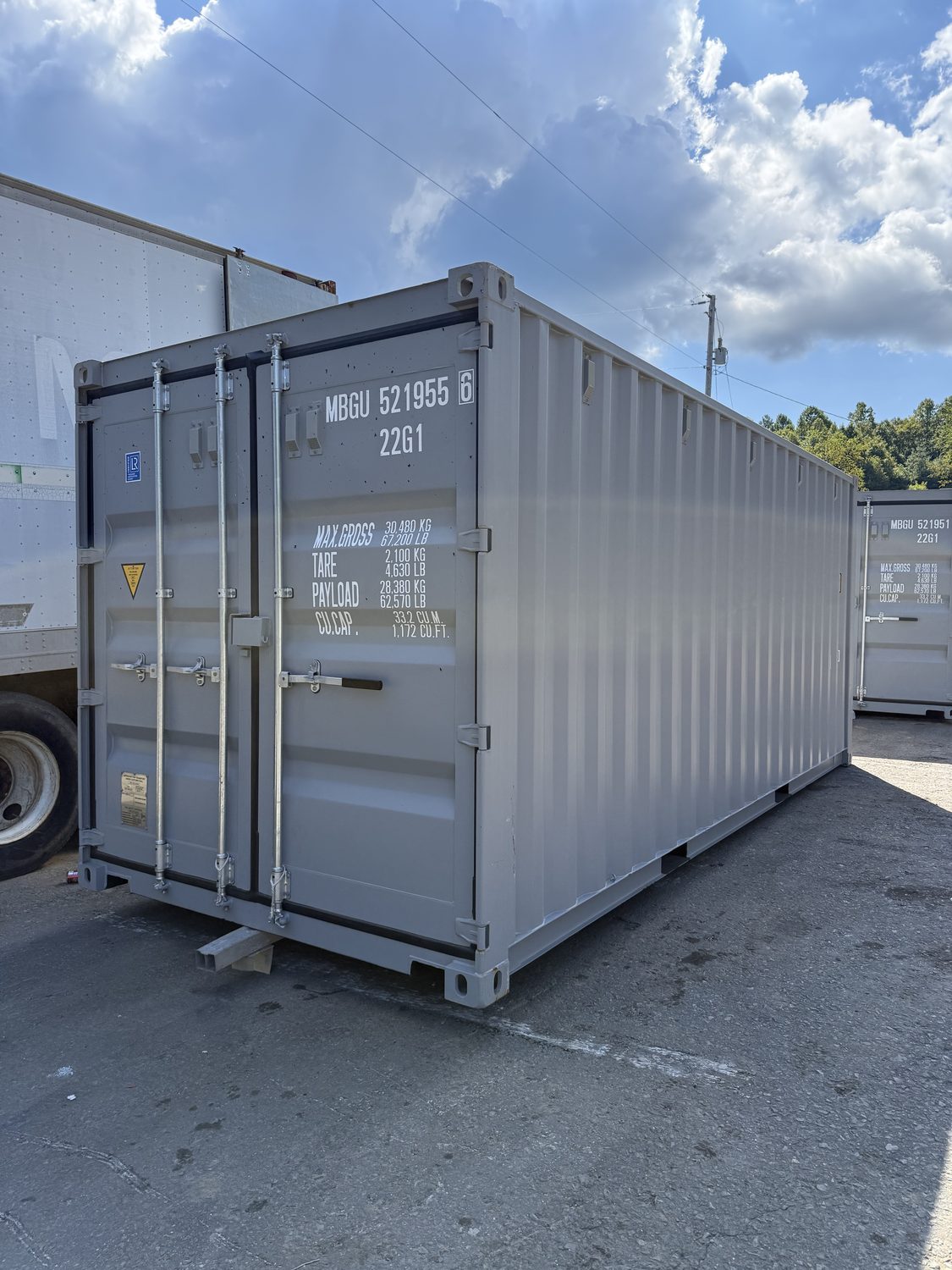
Most people buying a first container are guessing about three things, and no website can stop them guessing. Whether 20 feet is enough. Whether the spot they picked in their head actually works. Whether a container is even the right answer to the problem. You can read about all three. You cannot know any of them from a page.
Renting for a couple of months settles all three with real steel on your own ground. It costs money you do not get back, so this is not a way to save. It is a way to quit guessing before you spend the bigger number.
The three questions a trial answers
A rental is usually a short answer to a short need: a build that wraps in the fall, a remodel, a busy season. There is a second use that gets talked about less. You rent because you are not sure, and sixty days of rent buys the answer at full scale, on your ground, with your own things stacked inside.
- Is 20 feet enough, or do I need 40? A tape measure gets you close. Then you stack badly, leave an aisle down the middle so you can reach the back, and a chunk of the space goes to air. Our 20 ft vs 40 ft guide gets you a starting guess. Two months of loading one your own way confirms it.
- Is this the right spot? The spot in your head has to survive a truck getting to it, ground that stays firm after weeks of weather, doors that open toward where you actually walk from, water that has to go somewhere in a hard rain, and how it looks out the kitchen window.
- Is a container the right tool at all? Sometimes the honest answer is a shed, a lean-to, or a rented unit in town. Our container vs shed comparison lays out the trade on paper. Living with one settles it for good.
The three go wrong in very different ways. Guess the size and you live cramped or buy a second box. Guess the tool and you own a large steel object you do not use. Guess the spot and you pay for another truck, which is the one nobody sees coming.
What the first month teaches you
Guides are written from the outside. Here is the part only your own container on your own ground can tell you.
How often you actually go in it. Some people open the doors twice a month. Some are in and out four times a day. That one fact drives how close it needs to sit, whether the walk matters in February, and whether you want a light in there.
Whether you walk around it or past it. A container is a wall. It changes every path across that part of your property, including the ones you take without thinking. Inside a week you know whether it sits out of the way or in the middle of everything.
How it breathes in your spot. The same box in a shaded hollow behaves differently from one in open sun with air moving around it. Condensation depends on your ground and what you keep inside, not on the steel. A trial tells you whether you need vents before you own the thing.
How your ground holds up over weeks of weather. A pad that is fine in August can go soft in a wet spring. Corners settle, ruts appear where the truck came in. Better to watch that happen under a box that is going back anyway.
The placement lesson is the one worth the money
If a trial teaches you nothing else, let it teach you this. A container is cheap to place and expensive to move, and almost nobody thinks about that in the right order.
Getting it there took a tilt-bed truck with a long straight run to slide the box off: roughly 65 feet of clear line for a 20-ft unit, about 95 feet for a 40-ft, plus room to back in. Now picture shifting that container fifteen feet a year from now. Same truck, same clearance, same firm ground. That is not an adjustment. It is a second delivery, and you pay for it like one.
Then there are the doors. On a standard unit they sit on one end, and everything about how you use the box flows from which way that end points. Whether you can back a trailer up to it. Whether both leaves swing open without catching a fence. Set the door end three feet off a property line and you have built a very heavy closet you cannot open.
Door direction is the detail people think about least and regret most. It costs nothing to get right on delivery day, when the driver is standing there asking which way you want it faced, and a whole truck to fix afterward. Live with the doors toward the driveway for a month, decide they should have faced the shop, and the box you buy goes in the right way around the first time.
The honest arithmetic, plainly
Here is the part a page like this usually skips. A trial is not free, and you should not assume it is. What you should also not assume is that the rent is simply gone: if you rent for a while and then decide to keep the container, in many cases we can credit a portion of what you have already paid toward the purchase price. That is worth asking about when you book rather than guessing in either direction, because it changes the arithmetic. See container rentals for how that works, and ask us on the phone what it would look like for your situation.
So look at the size of the numbers instead. A rental runs from $165 a month with no contract and nothing holding you past the current month. A used cargo-worthy 20-ft container starts at $3,200 delivered inside 75 road miles of the Woodlawn yard, and a used 40-ft starts around $4,900 delivered. A couple of months of rent is small next to either, and very small next to buying the wrong size twice.
That makes the trial insurance, and insurance follows a simple rule: worth buying when the risk is real, a waste when it is not. If you do not know the size, or the spot has three unknowns in it, the risk is real. If you already know, you have just paid extra for your container. Our buy vs rent guide walks the longer-run math, including where months of rent add up to what owning costs.
Who should skip the trial and just buy
We rent containers, so understand what we are giving up by putting this in writing. Plenty of people should not bother with a trial.
- You have owned one before. You know how much fits in a 20, what the doors do in the cold, and where you want it sitting.
- The need is obviously permanent. Farm equipment locked up every winter from here on, or a shop's overflow that is not going anywhere. If the box is still on that ground in five years, every rent check is pure cost with nothing at the end.
- You are on open land with no placement doubt. Flat, firm, room for a truck to work, nothing in the sightline to argue about. Placement is the expensive question, and without it most of what a trial is for is already answered.
- You have already stood in one. If you have walked a 20 and a 40 back to back and know which one you want, do not pay rent to reopen the question.
If two of those describe you, buy. There is also a middle path that costs nothing. Come stand in one at the yard. Walking a 20 and then a 40 back to back does more for the size question than any amount of reading. The containers sit on gravel at 5567 Elk Horn Rd in Woodlawn, with a second sales lot in Wytheville at 2220 E Lee Highway, Monday to Friday, 8 to 5. Call ahead so units can be pulled where you can walk around them.
How the switch to owning works here
You call and tell us the trial answered the question, and what the answer was. We quote the purchase. If the answer was a 40 after two months in a 20, we quote the 40. If it was a different corner of the property, tell us where and we plan the placement around what you learned. If it was a different door direction, say so before the truck rolls.
If the answer was no, you call for pickup and the box goes. Month to month with no contract is what makes that possible, and a no is a perfectly good result. The trial did its job and saved you the price of a container you would not have used.
We will not put terms on a web page for a conversation that depends on the unit and what you want to end up with. Call (276) 237-6144 or email sales@containersdelivered.com, tell us what you have been renting and what you learned, and we will quote the purchase the same day. What we sell is on the container sales page, though the better move is to come look at the steel.