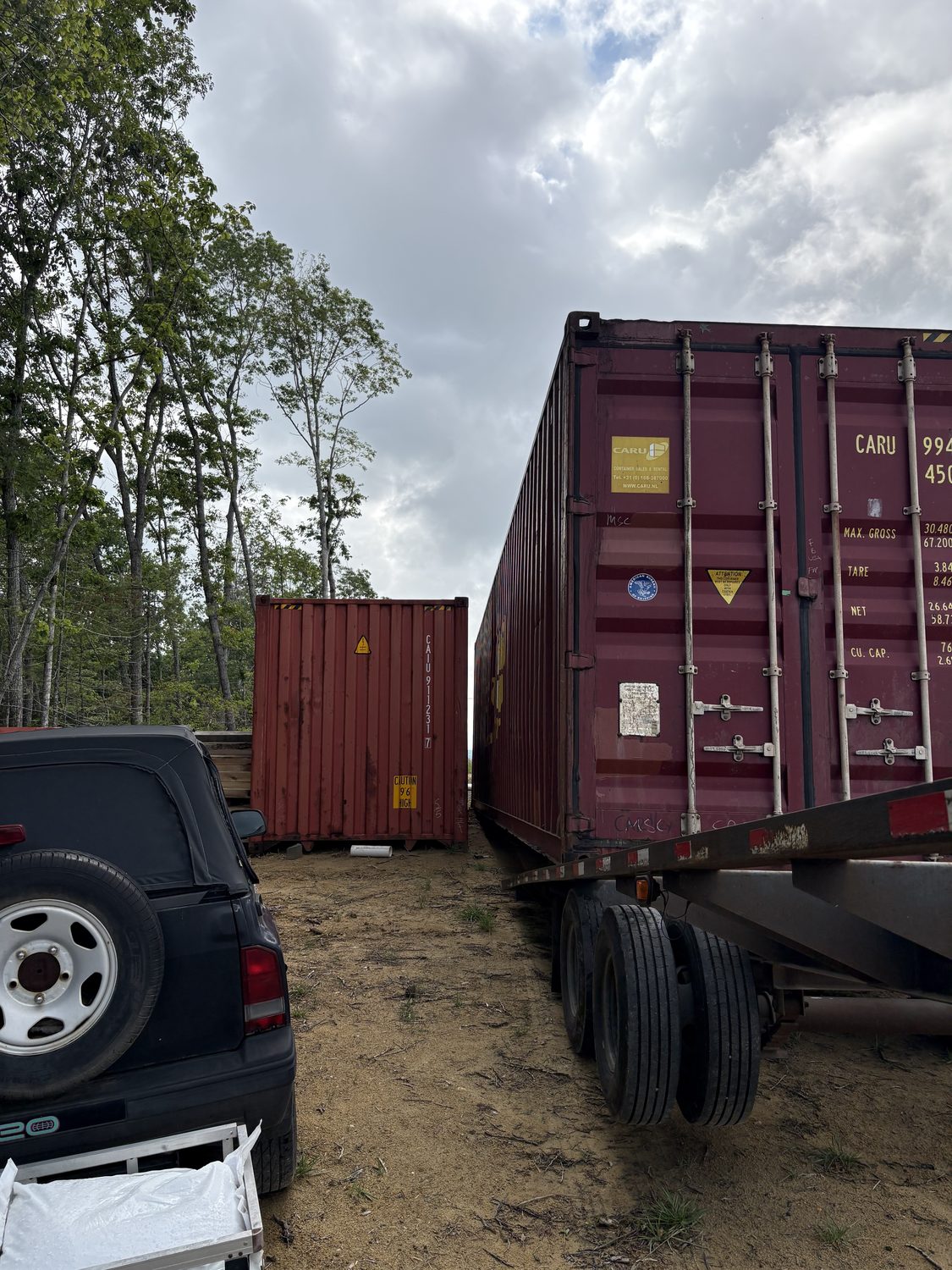
Most people are fine with the whole idea right up until the morning the truck comes. Then it lands on them that several tons of steel is about to get set down on their property. Fair enough. Here is the day, start to finish, so none of it is a surprise.
This page is about the day itself: who calls, what the driver looks at, the decisions you make while the truck is idling, and what happens when something is not what anyone expected. Getting the ground and the approach ready ahead of time is a separate job, and the delivery preparation guide covers that. Read it first if you have not.
The call ahead, and why you get a window
Before the truck leaves the yard you get a call or a text. Sometimes the day before, sometimes that morning, sometimes both. What you get is a window, not a time on the clock. That is not us hedging. It is how the day actually runs.
A delivery truck almost never has one stop. Loading at the yard takes as long as it takes. The stop ahead of you might have a locked gate, or an owner who is not home yet. Add a mountain road, a school bus and a wet morning, and a time promised down to the minute turns into a promise broken. A window is the honest version.
What we ask back is simple: keep your phone on you and answer it. The most common reason a delivery stalls is a driver sitting at the end of a driveway with a loaded trailer while nobody picks up. If you will be out of signal, give us a second number when you book. The driver will usually ring again once he is close, so you can walk out and meet him.
Same routine wherever we run, across southwest Virginia, southern West Virginia and northwest North Carolina. The service area page lists the towns.
The first two minutes on your property
A good driver does not pull straight in and start unstrapping. He stops, looks, and usually gets out and walks. Those first two minutes decide whether the rest of the day is easy.
Here is what he is reading:
- The approach. Can a truck and trailer get from the road to the spot in one piece? Width at the gate, the pitch of the drive, the crown where the drive meets the road, and any grade change sharp enough to hang up a trailer.
- Overhead. Power and phone lines, tree limbs, carport eaves. The front of the container ends up well in the air during the drop, so the sky over the whole route matters, not just over the final spot.
- The ground. He walks the spot and looks at what his own boot leaves behind. Firm gravel and dry packed dirt read one way. Ground that gives underfoot after a wet week reads another.
- Room to back and turn. Where does the truck turn around, and is there a straight run behind the drop point, or does he have to come in at an angle and reset?
- The spot itself. Is it square to the approach, is anything buried or stacked on it, and is there clear ground around it to swing the doors and walk both sides?
If any of that does not add up, he tells you right then, before anything is committed. That is the whole point of the walk. A problem found in the first two minutes is a conversation. The same problem found halfway through a drop is a wrecker bill.
Placement and door direction: the one call you have to get right
Then comes the only real decision of the day, and it is yours. Where exactly does the box sit, and which way do the doors face?
Standard containers have doors on one end only. Once it is on the ground, the doors point wherever they point. Nudging it a few feet is one thing. Turning it around is another truck, another driver, and paying for a trip you did not need to make. Spend the extra two minutes here.
Walk it with the driver. Stand where the doors will be and picture using the thing. Worth answering out loud:
- What are you going to back up to it? A truck bed, a trailer, a tractor. Leave yourself room to pull in and pull back out.
- Which way does the weather come from? Doors into the prevailing wind collect more rain at the sill and more snow packed against the bars in winter.
- Do the doors have room to swing? They open wide, and they want clear ground in front of them, not a fence line or the top of a bank.
- Might you add a second container later? Set the first one so the second one has somewhere sensible to go beside it.
- How does it look from the house and the road? The door end is the busy end, and plenty of folks point it away from the kitchen window on purpose.
How a tilt bed actually sets the box on the ground
Most of our deliveries go out on a tilt bed trailer, and once you have watched one work, every rule about clearance makes sense.
The truck backs the trailer toward your spot and stops short of it. The bed raises at the front until the back end of the container touches down. Then the driver eases the truck forward. The box is not lifted and lowered. It slides off the back of the trailer while the truck creeps out from under it, so the container is travelling backward across your ground even though the truck is going forward.
That is why the room in front matters more than the room around the box. Plan on roughly 65 feet of straight clearance for a 20-ft container and about 95 feet for a 40-ft, plus space behind that to back in and line up. If all you have is a parking space the size of the container, the truck has nowhere to go.
It is slow, and it is loud. Steel castings dragging over a steel bed make a noise like something breaking. Nothing is breaking. Stand well off to the side, keep kids and dogs indoors, and let the driver work. He is watching his mirrors and the back of the box at once.
Blocking, levelling, and the door test
The container comes to rest, and now the fussy part starts.
A container carries its weight on the four corner castings, not on the middle of the floor. The driver sets those corners on blocks so the box sits level, drains, and stays up off wet ground. On a good gravel pad that goes quick. On uneven ground it means jacking a corner, adding or shaving a block, and checking again.
Level is not cosmetic. The box is its own frame. Let one corner sit low and the whole thing racks a little, and the first place you notice is the doors: they get heavy, they stop lining up, the locking bars fight you. Set it level on day one and it stays square. The container foundation guide covers gravel, blocks and slabs in detail.
Before the truck leaves, do the door test with the driver standing there. Open both doors all the way. Swing them back. Close them, drop the bars, throw the handles. If anything binds or a bar needs a shove, say so now. Re-blocking a corner while the truck is still in the yard takes a few minutes. Doing it three weeks later means you, a bottle jack and a Saturday.
What goes wrong, and what happens next
Deliveries go sideways. Here is what actually happens when they do.
The ground is softer than it looked
This is the big one, and it is nearly always rain. A spot that carried a pickup on Tuesday will not carry a loaded truck and trailer on Friday. The driver walks it, and if it is going to give, he says so. Sometimes there is a way through: come in from a different side, stay on the gravel and set the box a little short of the mark, or lay boards across a soft stretch.
Sometimes there is not, and the delivery gets rescheduled. Nobody enjoys that call. The alternative is a truck buried to the axles and ruts across your yard you will be looking at for years. The driver makes that call standing on your ground, and he makes it to protect your property first.
The gate or the turn is tighter than it looked
Gateposts are always narrower in person, and a turn a car takes without thinking is a different animal for a truck with a loaded trailer behind it. Usually there is a fix on site: pull a fence panel, come in through the field, or set the container nearer the road than planned. Now and then the honest answer is that a shorter box fits where a longer one does not.
You change your mind once you see it
This happens more than you would think, and it is not a problem if you speak up fast. A container looks bigger on the ground than it did in your head. If it is sitting there and you realise it wants to be three feet over, or turned square to the fence line, tell the driver before he pulls out. While the truck is still hooked up, small moves are often doable. Once it is down the road, they are not.
The doors bind
You do the door test and one door will not line up. That means a corner wants another block or a shim. It is a normal part of setting a container, not a sign that anything is wrong. The driver re-blocks it and you test again.
What to have ready on the day
None of this asks much of you. Five things, and the day runs itself.
- Be reachable. Phone on you, ringer up, from the start of the window. A second number if you have one.
- Mark the spot. Stakes, spray paint, two cones, a couple of bricks. Anything that means the driver is not guessing.
- Know which way the doors go. Settle it before he arrives. An arrow scratched in the dirt works fine.
- Move the vehicles. Cars, trailers, mowers, the boat. Out of the approach and out of the drop area, not just shoved to one side.
- Have someone who can decide. Somebody on site who can say put it there without ringing three people first. If that is not you, tell us who it is and give us their number.
When the box is set and the doors check out, the driver walks it with you. Down one side, across the back, up the other side, doors open. You look at the floor and the seals, he shows you how it is blocked, and anything that came with the unit gets handed over. Then he pulls the trailer out, and you have a container.
That is the whole day. If you are still working out whether your spot will take a truck, call us at (276) 237-6144 before you book. We are on the phone Monday to Friday, 8 to 5, and we would rather talk it through now than turn a truck around later. You can also send us a photo of the spot, or start with the sizes over on container sales if you have not picked a box yet.