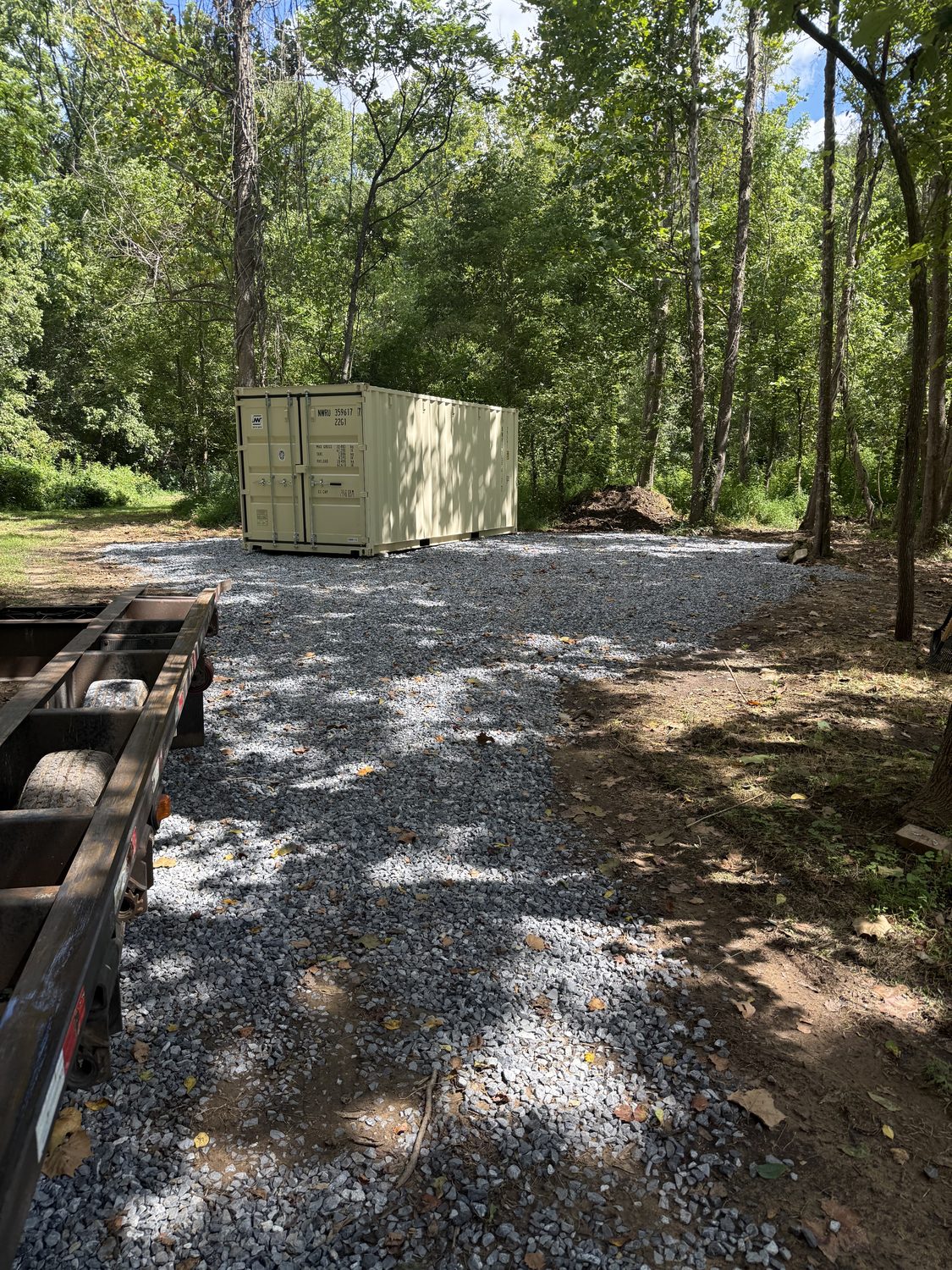
Every container quote we write starts from the same floor. A used cargo-worthy box, delivered, set and leveled, with a welded lockbox on the doors. A used 20-ft starts at $3,200 and the 40-ft at around $4,900. Both figures are out the door inside 75 road miles of Woodlawn. Ask for that same size in one-trip condition and the figure goes up. The distance between those two numbers is what people mean by the one-trip premium.
Here is the range, in the same words we use everywhere else on this site: a one-trip container typically runs several hundred to a couple thousand dollars more than a used box of the same size. That is as tight as an honest page can make it, because the gap moves with the size, with the market, and with what is standing in the yard the week you call. So this page is not going to add anything up for you. It will tell you what the extra money changes about the steel, and give you a plain way to decide whether your job needs any of it.
One-trip is a count, not an age
The name is doing something specific. It is counting voyages.
A container gets built at a factory overseas. It is loaded with freight, chained down on a ship, and carried across an ocean. At the far end it is emptied. What happens next is a decision somebody makes about that particular box: it either gets loaded again and stays in the worldwide pool, or it gets sold where it stands. A one-trip is one that got sold. Its whole working history is one load, one crossing, one unload.
Which is why the honest word for it is like-new and not new. A one-trip box has been lifted by crane, strapped down, and rained on for weeks at sea. It is a used container with the shortest resume you can buy, and the reason it looks the way it does is that not much has had a chance to happen to it yet.
It matters the way mileage matters on a truck. Two boxes off the same line, same ISO spec, same steel, can be nothing alike by the time they reach a yard. A grade name says how far along a box is, not how well it was built.
One-trip comes in the 20-ft, the 40-ft and the high-cube, and the sizes, dimensions and what actually lands on your property are all on the one-trip containers page. What follows here is only about the money.
Where the premium sits on a quote
The published floor is the used box. Put a 20-ft cargo-worthy unit on the truck and the figure is $3,200 delivered. The same grade in 40-ft is around $4,900 delivered. Both are out the door: the drive, the leveling and the welded lockbox are already inside the number within 75 road miles of Woodlawn.
The premium sits on top of whichever one applies to your size. Nothing else about the job changes. Same truck, same crew, same blocks under the corners, same lockbox welded on before we pull out of the driveway. The only thing that changed is which box got loaded back at the yard.
You will notice we have not printed a one-trip figure, and we are not going to. The range is wide because it honestly is wide. A number typed onto a web page has to survive being wrong for months, so it gets set where nobody needs to touch it. That is not a price, it is a cushion. We quote instead, same day. Tell us the size and we will put the used figure and the one-trip figure on the same sheet, and the premium stops being a range you have to imagine.
One boundary, so you know where to go next. Condition is one of several things that move a container price. The rest of them, size, distance from the yard, what the used market is doing, and any modification work, are on what drives container prices. If you are working out which size gives the most room per dollar, that arithmetic lives on cost per square foot. Everything we publish about pricing starts at the cost hub.
What the extra money actually changes
Four things, and every one of them is condition.
- The paint. A one-trip wears the coat the factory sprayed on it, unbroken and one color. A used box wears whatever its working life did to that coat: chalking, fading, and rust blooming through wherever the surface got opened up.
- The door seals. The rubber gaskets around the door leaves have a single crossing on them. They still compress the way they were designed to, and the doors shut without anybody putting a shoulder into them.
- The floor. Marine-grade plywood that has not spent years under forklift wheels, pallet corners and whatever leaked out of the freight. A used floor is sound. It also looks like it has been working.
- The hardware and castings. The steel fittings at the eight corners are still sharp and square, and the locking bars and cams swing without persuasion.
| What you are looking at | Used cargo-worthy | One-trip |
|---|---|---|
| Paint | Faded and chalked, surface rust in patches | The coat the factory sprayed, unbroken |
| Door seals | Serviceable, with years of compression behind them | Fresh gaskets, one crossing on them |
| Floor | Sound marine-grade plywood, marked from cargo | Clean marine-grade plywood |
| Corner castings and hardware | Scuffed and worn from years of lifting | Sharp, square, bars swing easy |
| Steel | 14-gauge Cor-Ten | 14-gauge Cor-Ten |
| Outdoor lifespan | About 30 years | About 30 years |
The bottom two rows are the honest part of this table. The premium does not touch them.
Now the part a page selling the upgrade ought to say out loud. Not one of those four items is structure. Both grades leave our yard wind and water tight, both are the same 14-gauge Cor-Ten weathering steel standing on the same marine-grade plywood, and both are good for roughly 30 years sitting outdoors. The premium moves the finish. It does not move the engineering, it does not add years, and it does not buy a better lock, because the welded lockbox goes on either one before we leave.
When the premium earns its money
There is a clean test for this, and it has nothing to do with the container. It is about who looks at it.
Anything customer facing. A pop-up, a retail add-on, a rental counter, a box parked anywhere the public parks. That container is doing a second job on top of storage: it is telling people something about the business standing behind it. Surface rust reads as neglect whether or not any neglect ever happened. That is unfair to a perfectly sound box, and it is also just how it reads.
Anything getting converted or finished out. If the plan involves cutting into the walls, one-trip steel is a cleaner cut and a cleaner weld, and smooth interior walls take paint, panels and insulation without a prep stage first. Starting from a rough shell does not delete that work. It moves it onto somebody's labor bill. If a shop, an office or any finished interior is where this is heading, part of what the premium buys is the first day of that build. See the custom modifications page for what is possible once the box is here.
Anything that has to look right where it sits. Beside the house. On a corner lot. In a neighborhood where somebody has an opinion, or in a yard your spouse also uses. A container that looks like it belongs where it landed is one you only have to discuss once.
In all three, you are not buying storage. You are buying storage plus an appearance, and the appearance has work to do. That is a real reason to spend real money.
When you should keep the money
Here is the sentence a page like this usually leaves out. Most of the people who call us do not need a one-trip, and we say so on the phone.
The bulk of what goes out of our yard is storage, and storage does not care what color the box is. If any of these is your job, buy used and put the difference where it does more good:
- A box behind the barn for hay, feed, fencing and the implements that will not fit in it.
- Tools, a mower and a compressor locked up at the back of a lot.
- Household and garage overflow parked while a renovation runs.
- A jobsite box that trades are going to scuff up in the second week no matter how it looked in the first.
- Anything sitting behind a treeline, behind a building, or far enough back that you only see it at a distance.
In every one of those, a used cargo-worthy box locks the same, seals the same, and outlasts most of what you are going to put inside it. The surface rust is cosmetic rather than structural, and behind the barn nobody is looking at it anyway.
That second half is not a throwaway line. A container on soft, wet ground will cause you more trouble over its life than faded paint ever will. Where a budget only stretches so far, firm level gravel under a used box beats factory paint on a box settling at one corner.
So tell us the size, the delivery ZIP and what is going inside, and we will quote both grades on the same sheet the same day. If the used box is the right answer for your job, we will tell you that too. Call (276) 237-6144, Monday to Friday, 8 to 5.